Woven By Toyota
MOVING WITH AGE
A study of how older New Yorkers navigate NYC transit, and two interventions designed to give them back control. The problem wasn't access. It was what happens when something goes wrong.
ROLE
UX Researcher
TIMELINE
Jan – May 2025
FOCUS
Research
Concept Design
METHODS
Field observation, qualitative interviews,
secondary research, journey mapping
The Problem
Older New Yorkers had the route. They still couldn't complete the trip.
Our research showed a consistent gap between what the MTA offers on paper and what actually happens for a 71-year-old navigating it alone.
The subway isn't inaccessible in theory. In practice, it breaks at the moments that matter most: unexpected service changes, crowded platforms, announcement systems that don't cut through ambient noise. For older non-commuters making a non-routine trip, each of those moments is a decision point, and the system gives them nothing to make that decision with.
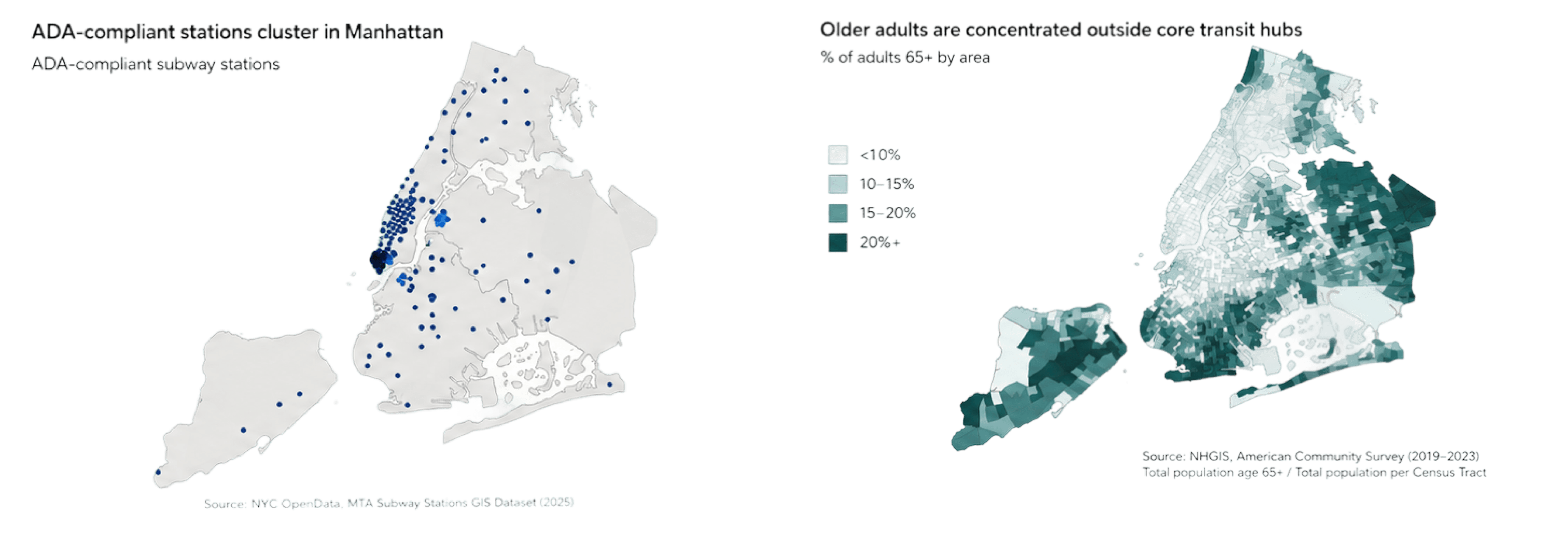
Key signals from research:
25% - Share of NYC's population projected to be 65+ by 2040
Most ADA-compliant stations are in Manhattan. Most older riders are not.
Workarounds are everywhere. Printed maps folded into wallets. Handwritten stop sequences. Family group chats used as real-time navigation. None of this should be necessary for a subway system as extensive as NYC's.
Core Insight
The system wasn't giving older riders less information. It was giving them the wrong kind.
More service updates don't produce more confidence. An announcement that says "delays on the 6 train" is technically information. For Margaret standing on a crowded platform with a suitcase, it's useless.
What older riders need isn't more data. They need interpreted, actionable guidance at the exact moment something goes wrong — and a support network that's built into the trip, not assembled in a panic after it breaks.
The first moment of uncertainty had to have a clear next step already waiting.
Design Tenets
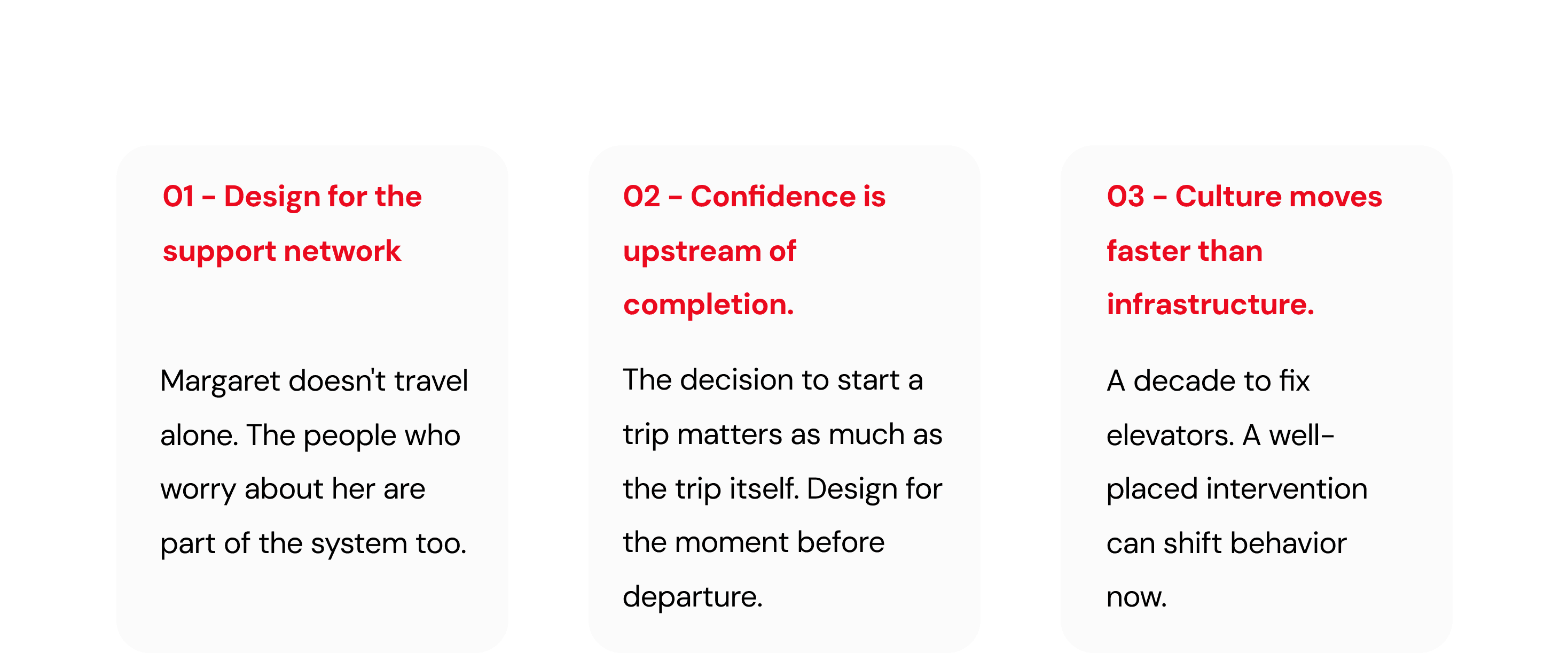
Three principles shaped both solutions.
Key Solutions
Two moves to put control back in their hands.
01 - Compass- A transit companion app built for the people who help.
The caretaker is already part of every trip. Compass makes them useful before anything goes wrong.
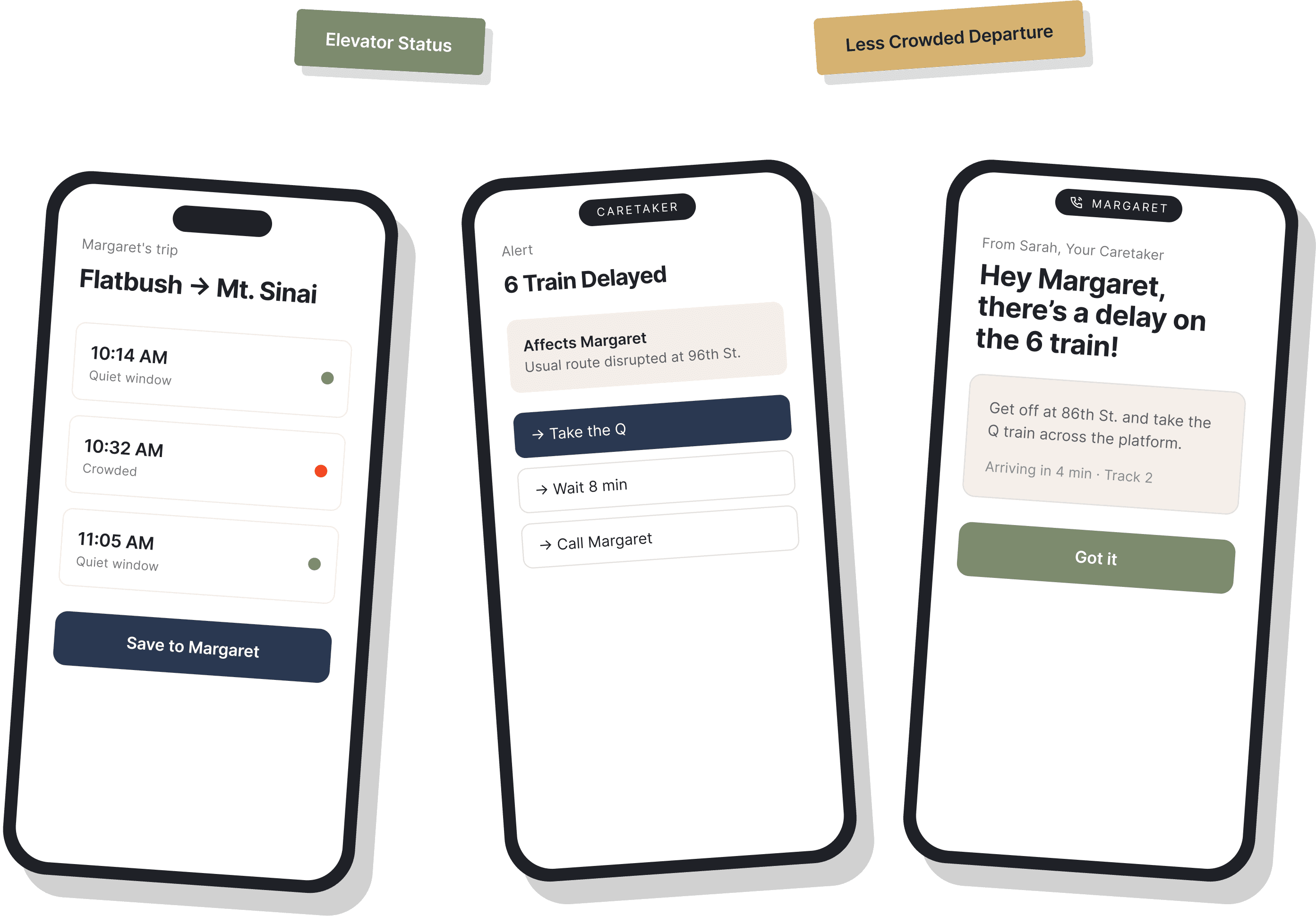
Before departure, the app surfaces quiet windows and flags elevator status at both ends. One tap saves the route to Margaret's phone. When the 6 train gets delayed mid-trip, the caretaker sees it first, and Margaret gets one card: plain language, alternate route, one clear next step.
No announcement to decode. No panicked phone call.
PLAN before the trip. ALERT when things change. LOG recurring routes so preparation gets faster every time.
02 - Social Signals- A visual and audio-first intervention inside the system that already exists.
Courtesy on the subway isn't absent. It's uncoordinated. People don't act because no one else is acting first.
Social Signals are designed within the MTA Graphic Standards Manual, so they live where commuters already look, not somewhere new. They don't demand courtesy. They permit it. A poster that says "offer your seat" gives someone a reason to do what they already wanted to do.
The social campaign extends it online. Riders share real moments of care. The norm spreads.
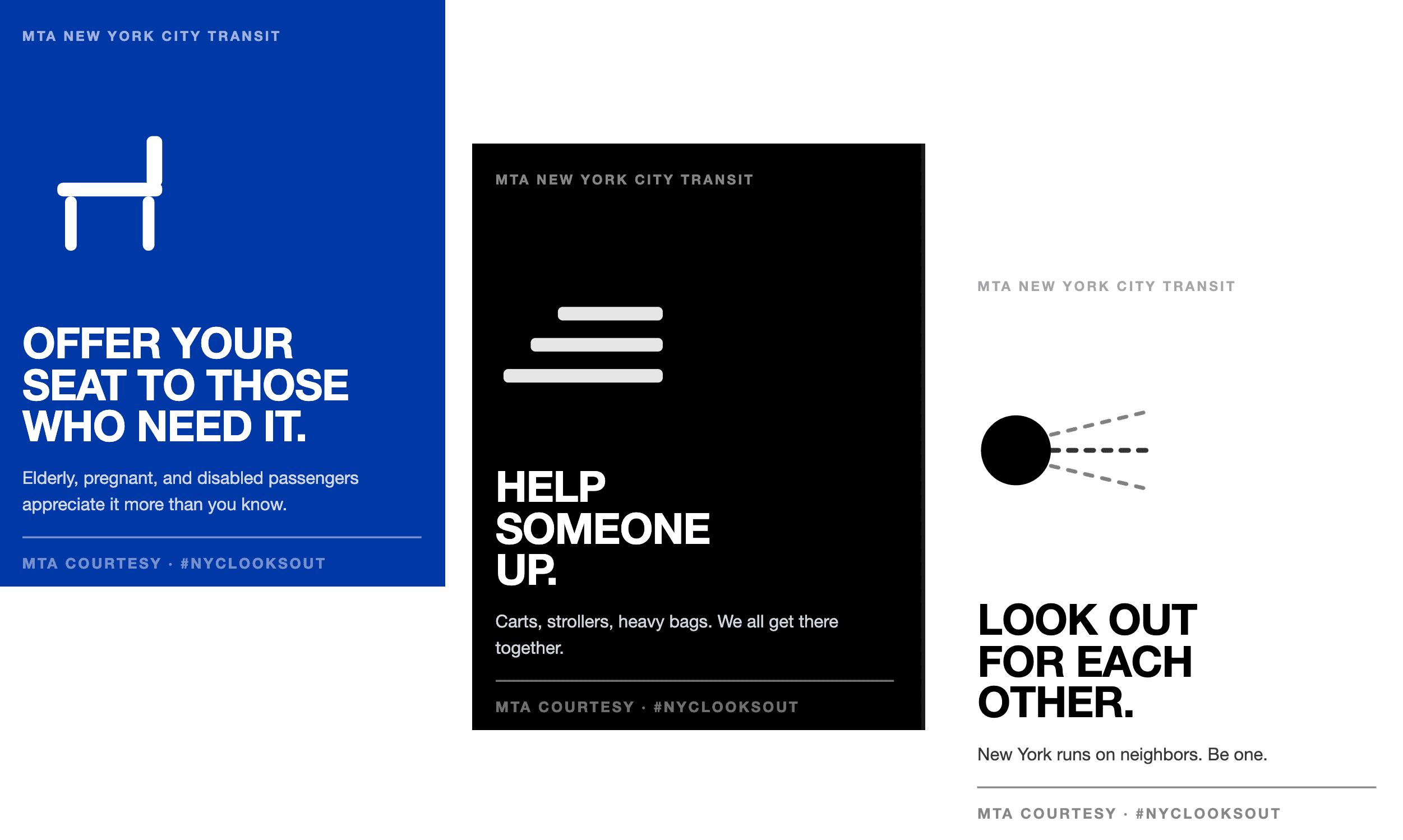
SHIFT commuter attention. SIGNAL a need in context. SHARE moments of care to reinforce the norm.
Research: Three methods. One consistent picture.
We tested three ways to capture taste.
We observed riders at two stations across two boroughs, a Manhattan transfer hub and an outer-borough local stop.
We ran qualitative interviews with older New Yorkers about specific trips and specific moments of breakdown. We audited MTA reports, NYC disability statistics, and online forums where older riders share workarounds.
Three methods. Three findings that each pointed in the same direction.
Finding 01 - Geographic mismatch. Most ADA-compliant stations sit in Manhattan. Most older riders do not live there. The parts of the network closest to communities with the highest concentrations of seniors are the least likely to have functioning elevators or APS signals.
Finding 02 - Uncertainty starts before the trip. Non-routine trips are the hardest, anything that takes a rider off a memorized route. The anxiety isn't just about the platform. It starts at home, when someone has to decide whether the trip is worth the risk.
Finding 03 - More information ≠ more confidence. Announcements compete with platform noise and worn intercoms. For someone with even mild hearing loss, a service change becomes invisible. Not unclear. Invisible.
Final Experience & Confidence Loop
A trip that starts prepared and ends without a phone call.
The final experience gives older riders and their support networks two things they don't currently have: preparation before the trip and one clear action when something breaks.
Before the trip: The companion searches Margaret's usual route. Elevator status checked at both ends. Quiet departure window flagged. Saved to her phone in one tap.
When something changes: A disruption hits the 6 train. The caretaker gets a notification. Margaret gets a pre-formatted alert card — alternate route already loaded, written in plain language. She doesn't have to call anyone.
On the platform: Social Signals prompt commuters to make space. Someone offers her a seat. The system gets human help from the people already there.
The loop is simple:
Prepared departure → real-time caretaker awareness → disruption absorbed before panic → trip completed → caretaker worry resolved → confidence to travel again
This turns a reactive support system into a proactive one. The family group chat becomes a structured alert. The workaround becomes the design.
Reflection
What I’d take forward
The hardest part wasn't designing the app. It was understanding why older riders cancel trips before they start.
We came in thinking the problem was physical: broken elevators, bad signage, inaccessible stations. Those are real. But they're not why Margaret calls her daughter in a panic mid-platform. The actual failure is interpretive, the system produces information but doesn't translate it for someone who needs a clear answer under pressure.
Workarounds are research data. The printed maps and family group chats aren't signs of struggle. They're design specifications written by the people the system forgot. Read them correctly and they tell you exactly what to build.
The goal wasn't a better transit app. It was a faster moment of clarity.